Should You Sell or Rent Out Your Bay Area Home in 2026?
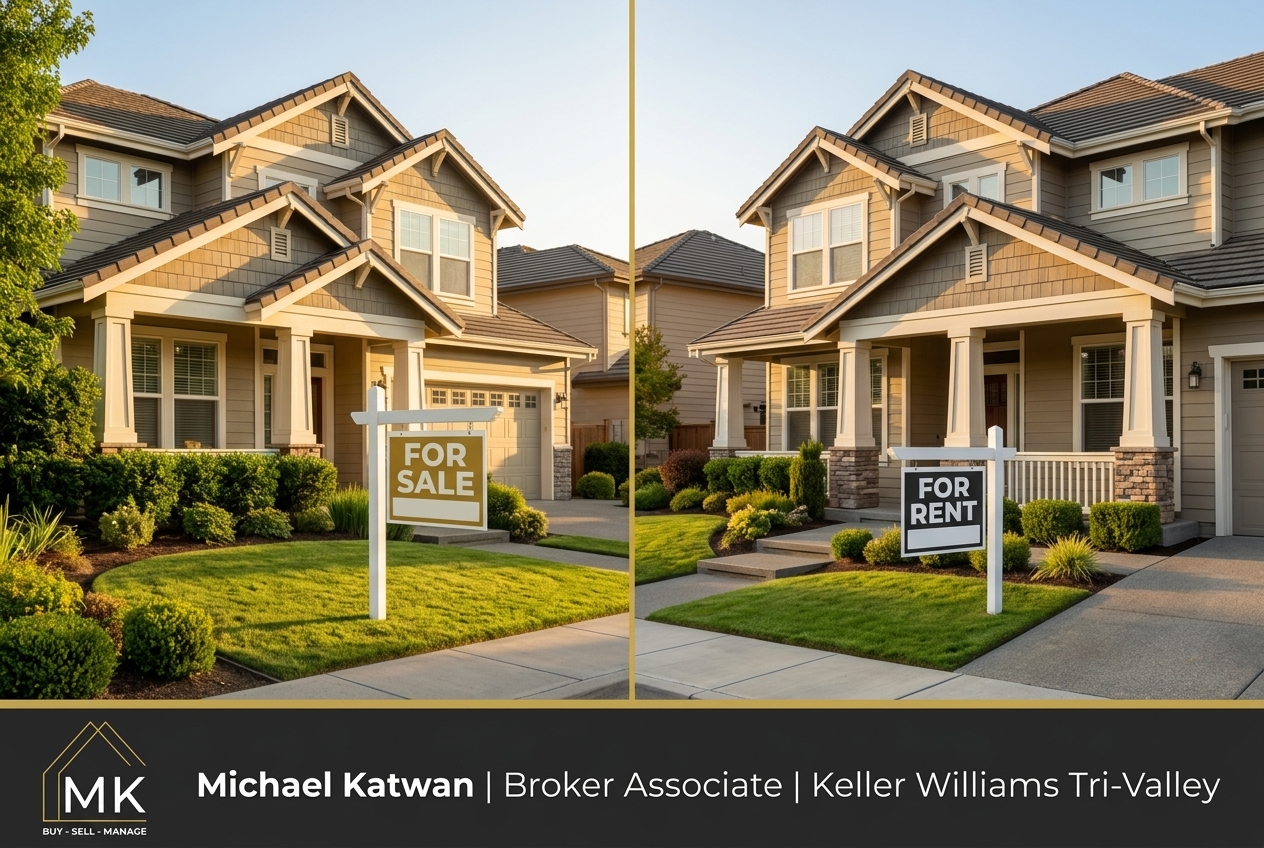
If you own a home in San Jose, Sunnyvale, Dublin, Pleasanton, or the wider Bay Area, the question usually starts simply: should I sell the house or rent it out?
But the real decision is bigger than that. You are not just choosing between a listing agreement and a lease. You are deciding whether this property should become part of your long-term wealth plan, whether you want the responsibility of being a landlord, and whether the market is offering you a price that is hard enough to pass up.
In a region where home values are high, rents are meaningful, and supply remains tight in many neighborhoods, the answer is rarely automatic. Some owners should absolutely sell. Others would be giving up a powerful asset too early.
The Bay Area version of this decision is different
In many parts of the country, selling versus renting is mostly a cash-flow calculation. In the Bay Area, that is only the first layer.
A Sunnyvale, San Jose, Dublin, or Pleasanton home can carry several kinds of value at once: current resale value, rental income, future appreciation potential, tax consequences, and optionality. Optionality matters. A home you keep today might become a future retirement asset, a move-back option, a 1031 exchange candidate, or a way to help family later.
That does not mean every property should be kept. It means the decision deserves more than a quick estimate from a rental website or a single Zestimate-style number.
Start with the three numbers that actually matter
Before you make an emotional decision, get clear on three practical numbers.
- Your likely sale proceeds. This is not the list price. It is the realistic net after commissions, preparation costs, transfer fees, mortgage payoff, and taxes you should review with your CPA.
- Your realistic rent. Use comparable rental homes, not wishful thinking. A well-presented single-family home near strong schools, commute routes, or major employment centers may rent differently than a generic online estimate suggests.
- Your true monthly carrying cost. Include principal and interest, property taxes, insurance, HOA dues, landscaping, repairs, vacancy allowance, and property management if you do not want to self-manage.
Once you have those, you can compare the property as a sale, a rental, and a long-term hold.
When selling may be the better move
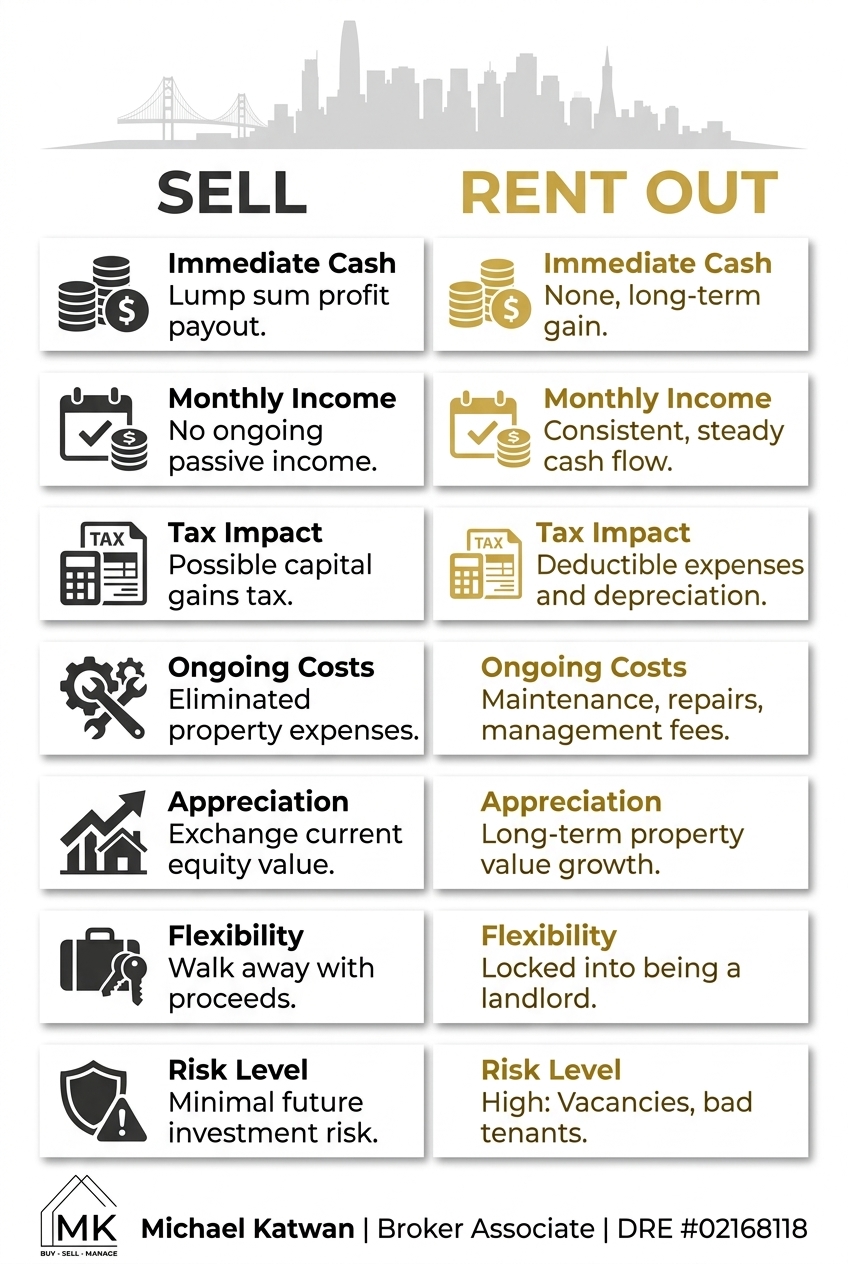
Selling can be the right answer when the property no longer fits your financial or personal life. A high-value home with low rent relative to its resale price may produce weak cash flow. A property that needs major capital improvements may be better sold before repairs become more expensive. An owner who needs liquidity for a new purchase, business investment, or life transition may be better served by converting equity into cash.
Selling can also make sense if you are inside a favorable tax window. Many homeowners know there is a primary residence capital gains exclusion, but the timing and eligibility rules matter. This is a CPA conversation, not something to guess on. If selling today preserves a tax advantage that may fade later, that can change the decision dramatically.
The cleanest reason to sell is this: the house is worth more to someone else than it is to your future plan. If the market will pay a premium and the rental return does not justify the risk, selling is not giving up. It is reallocating capital.
When renting it out may be the smarter long-term play
Renting can be powerful when the property sits in a durable rental market and you can carry it without stress. South Bay and East Bay rentals often benefit from strong employment bases, limited housing supply, and tenants who value access to schools, transit, job centers, and established neighborhoods.
Are you protecting your rental investment?
Michael offers a complimentary landlord audit covering rent optimization, compliance, and maintenance planning for Bay Area rental owners.
Get a Free Landlord AuditKeeping the property may make sense if:
- The rent covers most or all of the monthly cost after a realistic vacancy and repair reserve.
- You have a low mortgage rate that would be hard to replace today.
- The home is in a neighborhood with strong long-term demand.
- You do not need the equity immediately.
- You want to build a small real estate portfolio without buying a new investment property.
For many Bay Area owners, the strongest argument for renting is not immediate cash flow. It is control. You keep an asset in a supply-constrained market while someone else helps pay down the debt.
The landlord question: do you want the job?
A rental property is not passive by default. It becomes passive only when the systems around it are strong.
Someone has to price the rental, prepare the home, photograph it, market it, screen tenants, comply with fair housing rules, write the lease, coordinate move-in, handle maintenance, track deposits, respond to issues, renew or re-rent, and protect the property when something goes sideways.
Some owners are comfortable doing that themselves. Others want the benefits of ownership without becoming the point person for every repair, tenant question, or lease issue. That is where professional property management or a tenant-finding service can change the equation.
The honest question is not just, can this home rent? It is, can this home rent well without adding chaos to your life?
A quick Bay Area homeowner decision framework
If you are deciding what to do, use this framework before you commit either way.
1. If the home would be hard to replace, pause before selling
A low mortgage rate, a prime location, a large lot, or a flexible floor plan can be difficult to buy again later. If the property has qualities that will remain scarce, renting deserves a serious look.
2. If the property is maintenance-heavy, price the risk honestly
Older roofs, aging HVAC, drainage issues, older sewer lines, or deferred exterior work can turn a rental into a stressful hold. The property may still be worth keeping, but the reserve needs to be real.
3. If the numbers only work with perfect occupancy, be careful
A rental analysis should include vacancy, repairs, and management. If the investment only works when nothing goes wrong, it does not actually work.
4. If selling unlocks a better goal, do not cling to the house
Sometimes the best real estate decision is to sell and use the equity elsewhere: a trade-up home, a better investment, debt reduction, or more financial flexibility. The right answer is the one that serves the bigger plan.
What I would look at with you
For a Bay Area homeowner, I would want to compare both paths side by side:
- Estimated sale price and likely net proceeds
- Rental range based on current comparable rentals
- Preparation costs for sale versus rent
- Monthly carrying cost and reserve needs
- Tenant demand for that specific neighborhood and property type
- Tax questions to review with your CPA
- Your timeline, risk tolerance, and family goals
Only then does the answer become clear. Not because there is one universal rule, but because the tradeoffs become visible.
The bottom line
If you are wondering whether to sell or rent out your Bay Area home, do not make the decision from a single estimate. Make it from a real plan.
In San Jose, Sunnyvale, Dublin, Pleasanton, and surrounding markets, the right property can become a long-term asset. The wrong property, or the right property with the wrong management plan, can become a drain. The goal is to know which one you have before you move.
If you want a clear read on your home, start with a rental analysis and a sale estimate side by side. That will tell us whether your best move is to list, lease, or hold for the next chapter.
Request a rental analysis or review your selling options when you are ready to compare both paths.
Stay Informed
Get the Monthly Bay Area Market Report
Local market data, trends, and insights delivered to your inbox once a month. No spam.
No spam, ever. Unsubscribe anytime.
Michael Katwan
Broker Associate · Keller Williams Tri-Valley · DRE# 02168118

Michael Katwan
Broker Associate · Keller Williams Tri-Valley · DRE# 02168118
Have questions about what you just read? Book a free 30-minute strategy call — no pressure, just straightforward advice tailored to your situation.
Schedule a Call